

Learn how McDonald's has partnered with Zappi to build its test-and-learn approach to innovation, rather than a "test to earn a good score" approach.
The “care” category spans a wide range of areas — but can mainly be broken down into three major sectors: home care, personal care and pet care.
Historically, when it comes to advertising, all three of these sectors perform well in relevance, or how meaningful the audience finds their advertising to be. But since each of these are so different from one another, where do each of their advertising strengths lie? What about their weaknesses? And how can they improve?
We set to find out in this year’s State of Creative Effectiveness report.
Read on for a look into what’s working (and what’s not) in the care category today, based on what we discovered from our study of effectiveness data from over 4,000 US ads, as well as some examples of care industry advertising done right.
Download the report for our complete findings.
But first, let’s go over where the data comes from.
Developed in partnership with some of the world’s biggest consumer brands, Zappi’s Amplify Ad System combines the best thinking in advertising research to give a well-rounded and complete picture of creative effectiveness:
In-context exposure: Measures real media behavior, ad skipping, brand recall and purchase impact.
Emojis: Captures emotional response in an intuitive and globally relevant and representative way.
Forced exposure: Assesses key ad KPIs, social risk and direct consumer feedback.
With this approach, we get a full picture of creative effectiveness. We can also understand an individual piece of creative’s strengths and weaknesses to help diagnose issues and optimize it so it performs to its fullest potential.
Looking across the data from over 4,000 US ads collected with this methodology, we focused on the averages for each metric for each category — or in this case, the care category.
Keep in mind that these are the averages of the category, which means that many of the individual ads in those categories are stronger than the average and many are weaker than the average.
This helps us understand the general strengths and weaknesses of the whole category, not just individual brands within the category. This data can provide useful benchmarks for your individual ads and give a picture of how hard your advertising may need to work to overcome any common challenges for advertising within that category.
Now that we’ve covered our approach, let’s get into our findings.
As mentioned above, along with the other care categories, home care does very well in relevance.
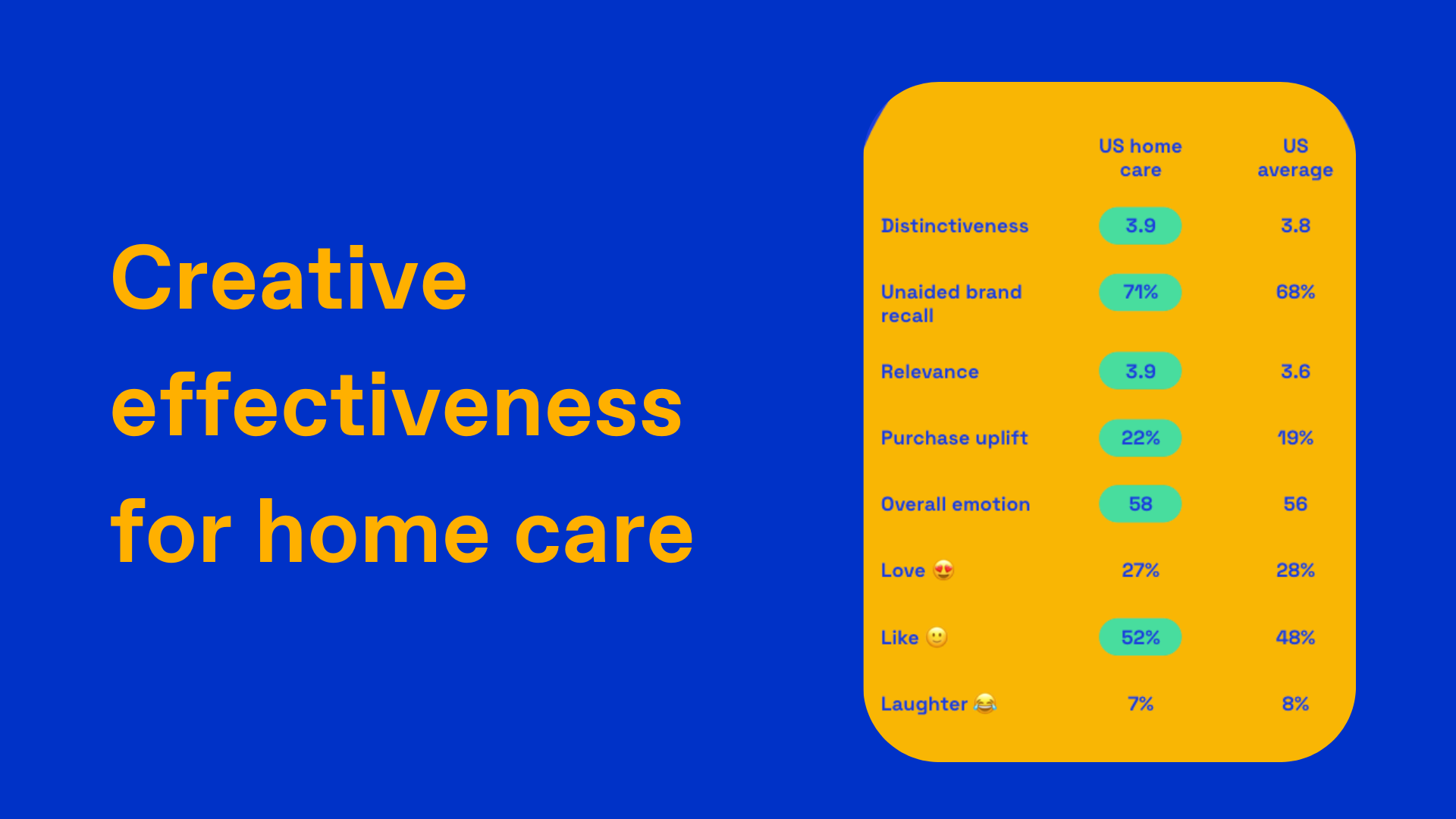
Home care also excels in brand recall, beating the average by three points. Many brands in this category have distinctive brand assets like Mr. Clean, Fabuloso’s purple color and Charmin’s bears — all of which certainly helps audiences immediately recognize the brand being advertised.
While it does outperform the average in overall emotion, that strength is coming from a higher “like” score, showing that audiences feel a little less strongly about home care ads than they could. The category is relevant to everyday lives, but ads have to work hard to make the category more emotive and special.
💡 Zappi advice: Focus on finding more ways to connect emotionally with your audience. Getting people to feel “like” after watching your ads is good, but “love” is a stronger and more meaningful emotion. And get your branding right across your ads. This category outperforms the average, but there is still room for improvement!
We found that overall, personal care does well in overall emotion (making people feel good while they watch the ad) and relevance (conveying things meaningfully).
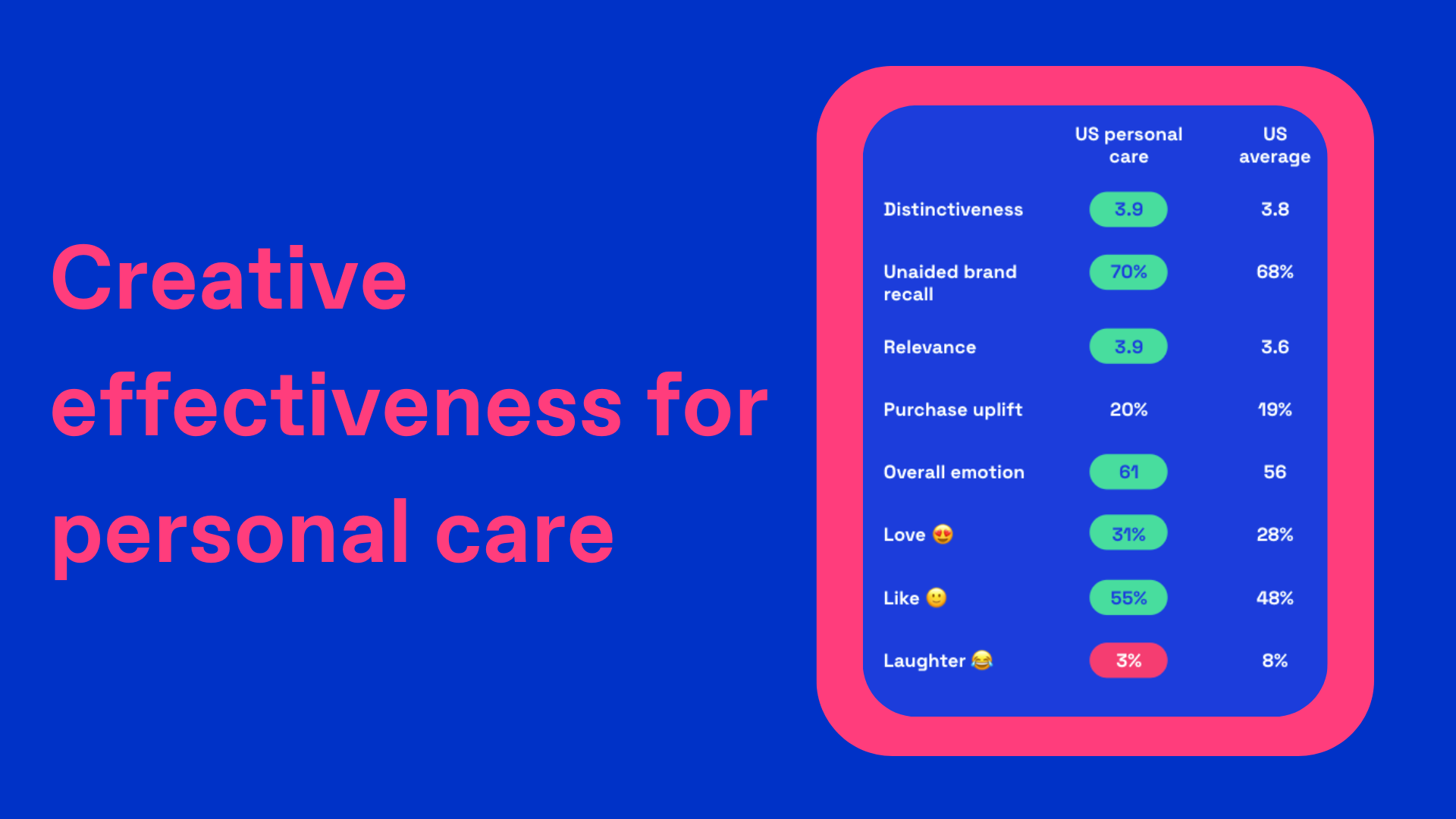
While resonating and being relevant is important, it's great to see that personal care ads can also be distinctive and stand out.
It’s also worth noting that personal care is one of the stronger categories when it comes to brand recall, which means that the creativity in the category is being harnessed for the brand more than the average ad.
💡 Zappi advice: This category scores the lowest in laughter among all the categories we looked at for this analysis. There’s an opportunity to use humor when it makes sense as a way to stand out compared to the usual way beauty is displayed in advertising. And while this category outperforms the average in brand recall, there is still room for improvement! Keep using DBAs, stay consistent (while fresh) and give the brand a clear role in the story to ensure branding remains strong in each and every ad.
Petcare is one of the strongest categories we looked at! A key driver of that success is that it has the highest overall emotion score, driven by its strong love score (39% vs. the 28% US average).
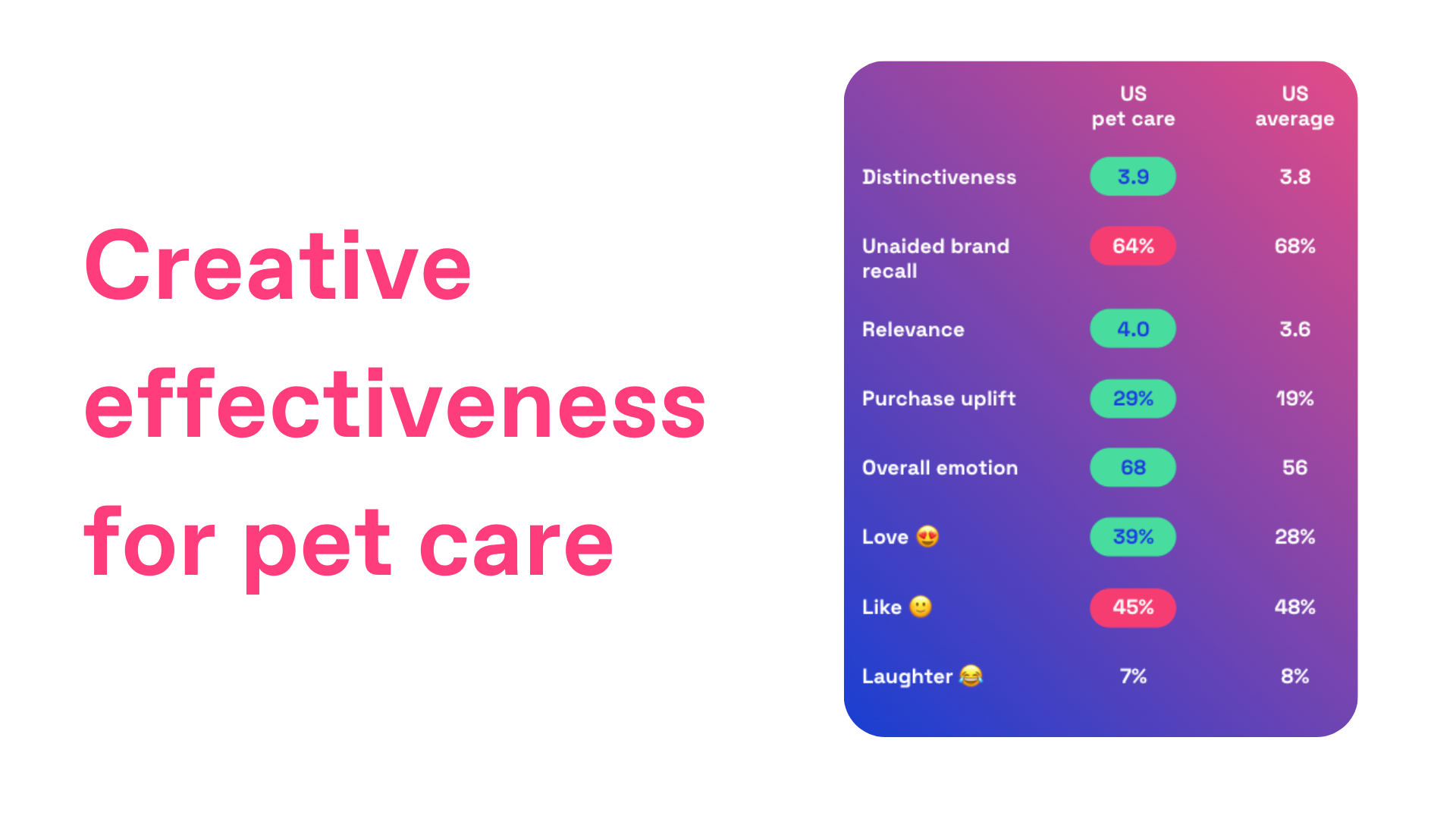
It makes sense that a category focused on animals does a great job of making people feel something by reminding them of their love for their pets. While animals alone don’t make a great ad, they certainly do help! So there's a real opportunity here to use people's love for their pets in emotive and engaging ways.
The category, like the other two, also significantly overperforms the average on relevance.
But it’s worth stating that this category does struggle to harness that love and relevance for the brand, coming in at below the US average in brand recall (64% vs. 68% average).
💡 Zappi advice: Branding is the most important thing to focus on for this category. It's important to ensure that the story told and the animals used are harnessed for the brand, so the campaign helps you grow your market share.
Here’s a few examples of brands who did a great job at advertising within each of these categories:
There’s a common misconception that feelings of like and love in advertising are best evoked through heart-warming storylines, grand gestures, etc. But these emotions can also be elicited in more understated ways by showcasing relatable situations and conveying a level of familiarity.
Tide does an excellent job at doing just that in their “Stains Happen to the Best of Us” ad, which shows Olympic athletes spilling condiments, drinks and more on themselves.
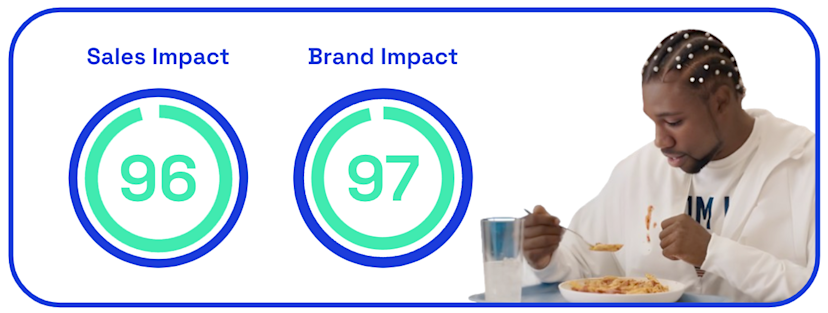
While creating an emotional connection is a common struggle for home care advertising, this spot is a great example of a home care ad that connects with the audience through the relatability of the message, making the ad emotionally engaging and enjoyable throughout.
We found that the personal care category scores the lowest in laughter among all the categories we looked at, signifying an opportunity to stand out in this area of advertising.
Dove is a great example of a brand that flipped the script on what we’re used to for the category with their “Moist Humor” ad.
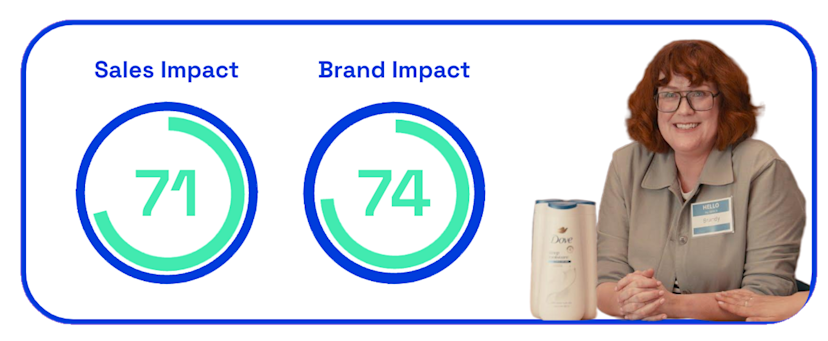
Instead of the typical serious, pulling-at-the-heartstrings approach from the brand (and for the category) viewers found this spot highly entertaining and humorous, receiving a much higher than average laughter reaction from viewers (22% vs. norm of 8%). But despite the departure from Dove’s traditional advertising approach, audiences were still easily able to recognize it was a Dove ad and found it to be both funny and informative — a combination that truly made Dove stand out from the category.
As we mentioned before, pet care ads tend to evoke a whole lotta love, but can tend to struggle when it comes to branding and ensuring that the story and animals are harnessed for the brand.
Pedigree does a fantastic job at not only including those lovable pets, but making sure their role in the story ties back to the brand in their “Love at First Sight” campaign. And even though they’re only 15 seconds long, both spots are able to tell a full, emotionally engaging story in a very short period of time!
The first spot, “Party,” shows a man all dressed up at a party, professing his love to someone off-screen as confetti falls, which turns out to be a dog in an adoption center. The ad promptly concludes with the words “Love at first sight isn’t just in the movies. It’s available at your local shelter.”
The second, “Rain,” depicts a woman standing in the pouring rain, exclaiming, “I’ve wanted an eternity with you from the second I met you!” The one she’s shouting to is again a dog at an adoption center, concluding with the same words on-screen.

Both spots do an excellent job at delivering the brand’s message and evoking a strong emotional response, showcasing that in spite of the story and message revolving around adopting dogs from a shelter, Pedigree played enough of a role for people to feel more positively towards the brand as a result.
There’s many things that brands in the care category can learn from consumers about what’s working in their advertising and what’s not.
For more on how to create ads that win with consumers, download our report for a deeper dive into our findings, including:
How creative effectiveness varies among different ages and genders
The impact of various advertising characteristics on effectiveness, like the use of celebrities, music, AI, etc.
Strengths and weaknesses of different categories including CPG food, QSR, alcoholic beverages, financial services, telecommunications and more
Helpful tips and examples to help you develop your most effective creative — including guidance from our partners at VaynerMedia, an integrated strategy, creative and media agency
Download the report to get our complete findings.